Building Block Packaging: A Retail-Ready Buyer's Guide
Quick answer: building block packaging is not a graphics job. It is part of the product's compliance file and part of its retail performance. Before artwork is finalised, settle four things: the pack structure, the warning and traceability text each market requires, the barcode and who owns it, and how the instruction booklet is carried. Change any of them after printing and you reprint the run.

Key takeaways
- US rules put the small-parts warning and a permanent tracking label on the packaging, plus a separate origin marking for imported goods.
- EU rules allow the CE marking on the packaging, but require both the manufacturer's and the importer's identity to be affixed.
- EU packaging material rules change on 12 August 2026, so today's specification may not hold for a decade.
- Freeze artwork only after the compliance text, identifier data and instruction booklet are approved.
Contents
- Why packaging is a compliance surface
- The three levels of packaging you are specifying
- What must appear on a building block set pack
- United States: small-parts warnings and the tracking label
- European Union: CE marking, two identities and the 2030 transition
- Packaging material rules are changing
- Barcodes, identifiers and retail routing
- Designing the pack around the product
- The artwork freeze sequence
- What to put in the packaging brief
- What to verify with a supplier
- Frequently asked questions
Why packaging is a compliance surface
What a buyer sells in a construction set is not one object but a piece count, an age grade, an assembly sequence and a finished model, and several of those are regulated rather than chosen. A plush toy can change its packaging artwork between runs with little consequence. A construction set cannot, because the pack states the piece count and age grade, and both are tied to the testing behind the product. The pack is also one of the places where traceability and operator identity must appear, which makes it a legal surface rather than decoration.
That is why packaging belongs in the same brief as the product. CAYI's private label building blocks guide makes the same point from the branding side: artwork, instructions and product must stay aligned through production, and alignment is cheaper to design in than to retrofit.
The three levels of packaging you are specifying
When a buyer says "packaging", they usually mean the retail box. A custom order has three levels, each carrying different information and decided by a different party.
| Level | What it is | What it carries | Who decides |
|---|---|---|---|
| Unit pack | The retail box, pouch or display pack the consumer buys | Brand, model image, piece count, age grade, required warnings, barcode, origin marking | Buyer, with the factory checking feasibility and print method |
| Inner pack | The bagged or tray-packed internal grouping of parts | Build stage or part family, quantity, sometimes its own bag label | Factory, driven by assembly sequence and piece layout |
| Master carton | The shipping carton the retailer or distributor receives | Units per carton, dimensions and weight, article number, handling symbols | Buyer and factory jointly, driven by the receiving channel |
Most first-order problems come from treating the three levels as interchangeable: a brand approves an attractive retail box, then finds the distribution centre will not accept the carton because the article number is not on the outside.
Decide early whether the unit pack is retail-ready at all. A polybag with a header card is legitimate for a low price point or a distributor channel, but it will not survive a mass retail shelf, so that is a channel decision rather than a design one. Where a project is still between private label and full custom, the OEM and ODM comparison shows how much of the pack the buyer controls in each case.

What must appear on a building block set pack
This table is the working checklist. It covers the pack, not the toy, because the toy itself is covered in CAYI's building block toy safety standards guide.
| Element | United States | European Union | Great Britain |
|---|---|---|---|
| Small-parts warning | Required for toys and games for children from 3 to under 6 years that contain a small part | Required where the age guidance excludes children under 3, or where the toy presents a specific hazard | Follows the UK toys regulations; check current guidance rather than copying EU wording |
| Age grade | Must be stated and consistent with the product and its testing | Must be stated and consistent across pack, product and marketing | Same consistency requirement |
| Traceability mark | Permanent distinguishing marks required on the product and its packaging | Batch or serial identifier required so a specific unit can be traced | Equivalent traceability expectation |
| Manufacturer identity | Identified through the tracking label | Manufacturer name and address must be affixed | Manufacturer details must be available |
| Importer identity | Private labeler identified where applicable | Importer must affix its own name and address | Importer details required |
| Conformity marking | No CE-style mark; certification is a separate document | CE marking, allowed on the toy, an affixed label or the packaging | UKCA or CE depending on the current rules and route |
| Country of origin | Required on imported articles or their containers | Usually carried within the manufacturer or importer block | Same expectation |
| Barcode | Retail scans require a registered product identifier | Same, in the identifier format the destination uses | Same |
| Language | Warning statements must be in English | Warnings must be in the language or languages of the consumer | English |
Compliance note: this table is a planning aid, not legal advice, and does not replace the applicable regulation or professional review for your product, age grade and market. Confirm exact wording and placement against the current text before print.
United States: small-parts warnings and the tracking label
What 16 CFR 1500.19 requires
The US small-parts warning is a rule about placement, contrast and type size, not only content. Under 16 CFR 1500.19, a toy or game for children aged 3 to under 6 that contains a small part is misbranded if the required statements are missing from the packaging or from any descriptive material accompanying it.
Four requirements catch buyers out:
- It is a block, not a line. The statements must be grouped in a square or rectangular area, with or without a border, so they appear on at least two lines.
- It needs a solid background. Design, illustration or proximity to other labels must not obscure it.
- It belongs on the principal display panel. A side or back panel is not the default. A narrow small-package alternative exists, with its own conditions.
- Type size is set by panel area. Letter height scales to the area of the principal display panel, with different sizes for the signal word, the hazard statement and the remaining cautionary material.
The statement combines a signal word, "WARNING" or "SAFETY WARNING", with a statement of the principal hazard, which the regulation identifies as "CHOKING HAZARD", plus remaining cautionary material such as the age guidance.
The requirement follows the age grade, so extending an age range can change it. And US states are pre-empted from imposing different small-parts or choking-hazard labeling requirements for toys, games, marbles, small balls and balloons, so one compliant panel serves the US market.
The CPSIA tracking label
Under 15 U.S.C. 2063(a)(5), the manufacturer of a children's product must place permanent, distinguishing marks on the product and its packaging, to the extent practicable. The marks must let the manufacturer work back to the location, date of production and cohort - the batch, run number or other identifying characteristic - and must let the ultimate purchaser identify the manufacturer or private labeler and the same cohort information.
Two consequences follow. A private label programme has to decide whose identity appears, because the text distinguishes manufacturer from private labeler. And the batch code has to match the code the factory uses internally, otherwise the trace leads nowhere.
Country of origin marking
Imported goods also need an origin marking. 19 CFR 134.11 requires every article of foreign origin, or its container, to be marked in a conspicuous place as legibly, indelibly and permanently as the nature of the article or container will permit, indicating to an ultimate purchaser in the United States the English name of the country of origin, at the time of importation. Where an article is excepted from marking, its container still has to carry the country of origin unless the container is also excepted.
"As permanently as the nature of the article will permit" does real work here. On a printed retail box the marking is straightforward; on a polybag, an unprinted part, or a set whose box is designed to be discarded, the analysis differs. Settle that with the importer of record before artwork goes out.
European Union: CE marking, two identities and the 2030 transition
Where the CE marking and identity information go
The current framework is the Toy Safety Directive 2009/48/EC, which is unusually explicit about packaging. According to the European Commission's guidance on placing toys on the EU market, a manufacturer must affix the CE marking to the toy, either directly on the toy, on an affixed label or on the packaging; affix their name and address plus a traceability element such as a batch or serial number; and ensure the toy is accompanied by instructions and safety information and bears the required warnings.
Importers must ensure the conformity assessment and technical documentation exist, keep a copy of the EC Declaration of Conformity, ensure the CE marking is affixed, and affix their own name and address. Distributors must verify the CE marking, the manufacturer's identity and traceability element, and the importer's identity.
So an EU-bound pack normally accommodates three things in addition to the brand: the CE marking, the manufacturer's name and address with a traceability element, and the importer's name and address. That is a layout problem, which is why EU artwork cannot simply be the US artwork with a mark added.
Warnings in the language of the consumer
Language is the second difference. US warning statements must be in English; in the EU, warnings must be understandable to the consumer in the market where the toy is sold, so the pack has to be planned for the languages of the countries you ship to.
One detail gets discovered late. The US rule permits the warning on another panel in a narrow case involving a very small principal display panel and a full statement in three or more languages elsewhere, with a pointer on the principal display panel. A range designed for both markets can sometimes satisfy both regimes with one panel plan, but only if the plan precedes the artwork.
The coming digital product passport
Regulation (EU) 2025/2509 on the safety of toys was adopted on 26 November 2025, repealing Directive 2009/48/EC. It enters into force on 1 January 2026 and applies from 1 August 2030 after a transition period of four and a half years. All toys will then need a digital product passport carrying compliance and other information, immediately accessible via a data carrier.
For a packaging programme with a multi-year life, a data carrier has to live somewhere on the pack, and that space should be reserved now rather than added to a dieline in 2029. The custom mini figures sourcing guide reaches a similar conclusion on the product side - designs with a long shelf life need their documentation planned, not improvised.
Packaging material rules are changing
The EU is also rewriting the rules on packaging itself, a separate regulation from toy safety and less often on a buyer's checklist. Regulation (EU) 2025/40 is in force since 11 February 2025 and applies from 12 August 2026, having replaced the earlier Packaging and Packaging Waste Directive.
According to the European Commission's packaging waste overview, it aims to make all packaging on the EU market recyclable in an economically viable way by 2030, safely increase the use of recycled plastics, decrease the use of virgin materials, and improve recycling and the single market through harmonised rules applying in all member states.
Three practical implications:
- Material choice gains a deadline. A window box, a laminated rigid box and a plain carton do not share a recyclability profile.
- Overpackaging has less headroom. A construction toy pack is often larger than the contents require, partly for shelf presence.
- Marking becomes more structured. Packaging identification is more than the familiar recycling triangle, and those marks belong in the dieline from the start.
Because implementation guidance is still developing, confirm the current position for your material and market rather than assuming today's specification holds through 2030.
Barcodes, identifiers and retail routing
The barcode is the smallest element on the pack and the one most likely to stop a shipment at a retailer's receiving dock. GS1 describes EAN/UPC barcodes as printed on virtually every consumer product in the world and the most widely used of its barcodes, encoding the identifiers that let retailers and manufacturers track products through the supply chain.
Who holds the identifier. An identifier identifies a company's trade items, so it should be held by the party that owns the brand and will still exist at reorder. If a factory or intermediary supplies one registered to someone else, the brand cannot control or maintain it, and mismatched registration is a known cause of rejection at receiving.
What the receiver needs. Retail point of sale, a distribution centre and an e-commerce fulfilment centre do not scan the same things: mass retail wants scannable identifiers and often specified dimensions and hanging features, distributors want carton-level identification, and e-commerce needs the unit pack to survive parcel handling without a shelf.
Designing the pack around the product
Communicate the build, not just the object. The buyer is purchasing a model that does not exist yet, so the front panel has to show the completed build clearly enough to work at thumbnail size on a marketplace listing as well as on a shelf.
Carry the piece count honestly. Piece count is a primary purchase driver and a primary source of complaints. If the count on the pack does not match the box, the mismatch shows up as returns and negative reviews even when the model is correct. CAYI's building block quality control checklist covers how parts counting is verified.
State the age grade consistently. The age grade on the pack, the product and in marketing has to agree with each other and with the testing behind the product. Inconsistent claims are a common reason a pack is flagged in retail review, and in the US the small-parts warning runs off that same grade.
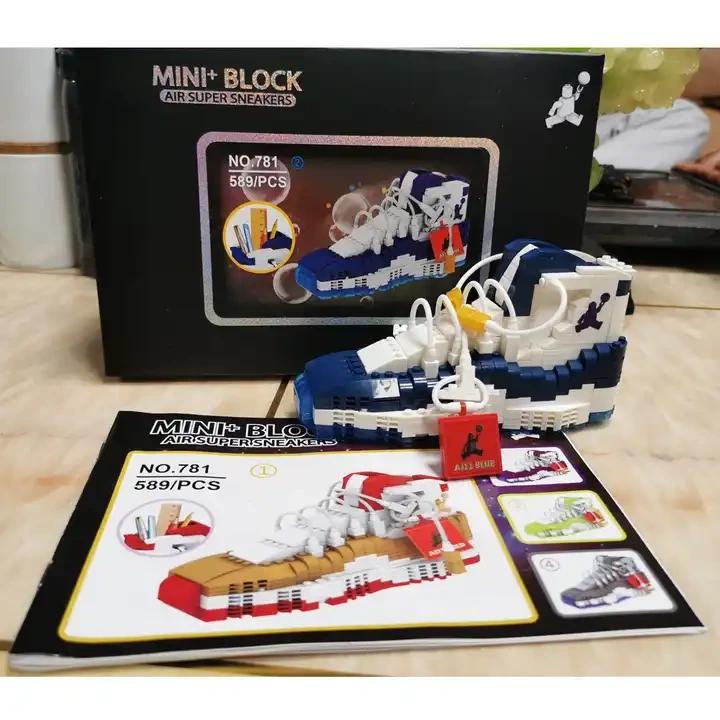
House the instructions properly. The instruction booklet is not an accessory: it makes the product usable, it is part of the safety information accompanying the toy in the EU, and it has to be carried without being crushed. A flat slot in a tray is a structural decision made with the box, not after it.

The artwork freeze sequence
Reprints are the largest avoidable packaging cost, and they almost always trace back to artwork being frozen before one of its inputs was settled.
| Step | Freeze this | Why it comes first |
|---|---|---|
| 1 | Destination markets and channels | Determines which labels, languages and markings are needed at all |
| 2 | Age grade and piece count | Drives the small-parts warning obligation and the front panel claim |
| 3 | Identity block: manufacturer, importer, traceability element | You cannot lay out a panel without knowing how many identities it carries |
| 4 | Product identifiers and their owner | Identifier data has to be supplied by the brand, not invented by the factory |
| 5 | Warning text, verbatim | Required wording and type sizes constrain the layout, not the reverse |
| 6 | Pack structure and dieline | Window, insert and instruction slot affect printable area |
| 7 | Artwork | Only now can design work against a fixed set of constraints |
| 8 | Print proof and physical sample | Barcode, colour and material are checked on the real substrate |
The most common failure is jumping from step 2 to step 7, because the model artwork is the visible part of the project and the identity block is not. A pack that looks finished can still be unprintable, and that is usually discovered at proof stage, when a change is most expensive.
What to put in the packaging brief
| Field | What to specify |
|---|---|
| Unit pack format | Box, window box, rigid box, pouch with header card or display pack, and which channel it serves |
| Destination markets | Every country in the pack's lifetime, not just the launch market |
| Required markings | Which conformity marking, identity block, origin marking and warnings |
| Languages | The exact language set, and which panels carry which language |
| Identifiers | The identifier value and format, and confirmation that the brand holds it |
| Structure | Board or material, window, insert type, instruction slot, closing method |
| Master carton | Units per carton, dimensions and weight, article number, handling symbols |
| Packaging quantity | Whether packaging is ordered with the product or separately, and the overage for damage |
| Approval route | Who signs off the compliance text, who signs off the artwork, and in what order |
Two of these are shop-floor decisions. Packaging ordered separately creates a matching problem, because a reorder of 3,000 sets against 2,900 boxes has no good outcome. And compliance text should not be signed off by whoever signs off the design, unless that person is genuinely checking the regulation.
What to verify with a supplier
- Who drafts the compliance text? The buyer or its compliance party should approve it. A factory offering to write warning wording for a market it does not sell in is a warning sign.
- Which packaging steps are in-house? Printing, die-cutting, window patching and carton assembly are often split across suppliers, which tells you where a delay will appear.
- How is the barcode verified? Ask whether barcodes are scan-verified on the finished pack rather than assumed correct.
- What is the overage policy? Ask what happens when boxes are damaged or misprinted, and who carries it.
- How are revisions controlled? Ask how versions are named, who holds the master file, and how a change is prevented from reaching only part of a run.
These align with the wider evaluation in how to choose a custom building blocks manufacturer. Change control most often decides whether a long-running packaging programme stays consistent across reorders.
Frequently asked questions
Does every building block set need a small-parts warning?
Not every set, but more than most buyers assume. In the United States the requirement attaches to toys and games for children from 3 to under 6 years that contain a small part, so it follows the age grade. Changing a set's age range should therefore trigger a review of the packaging text.
Where must the tracking label go - the toy or the box?
Both, to the extent practicable. The requirement is for permanent, distinguishing marks on the product and its packaging, and the statute allows the Commission to exclude products where marking is not practicable. Allow for the mark on the product itself, not just the box.
Can the CE marking go on the packaging instead of the toy?
Yes. European Commission guidance states the manufacturer affixes the CE marking to the toy, either directly on the toy, on an affixed label or on the packaging. Its location is a layout choice; the conformity assessment behind it is not.
Do I need different packaging for the US and the EU?
Often one pack can carry market-specific panels, but not by default. The differences that matter are the small-parts warning format, the CE marking, the importer identity block and the language set, so a one-pack solution has to be designed as one from the start.
Who should own the barcode?
The party that owns the brand and will still be trading at reorder. An identifier identifies a company's trade items, so it should be held by that company and supplied to the factory as data. Mismatched registration is a known cause of rejection at receiving.
When should packaging artwork be finalised?
After destination markets, age grade, piece count, identity block, identifiers, warning wording and pack structure are settled, and before the print run. Earlier, it is likely to be reprinted. Later, it compresses the proof stage where colour and barcodes are verified on the real substrate.
Plan the pack before you plan the print run
Resolve these questions while the product specification is still open, because packaging and product decisions constrain each other. CAYI works with brands, importers and retailers on OEM and ODM programmes covering structure, printing, instructions and market compliance text, and the customization series and custom building blocks pages set out what can be specified.
Send us your destination markets, age grade and channel plan and we will tell you what the pack has to carry before anyone draws it.